39% dissatisfied with indoor temperature: What does research reveal about office conditions?
Blog
In an international workplace study, 39% of respondents were dissatisfied with the temperature in their buildings. The dataset included more than 90,000 respondents across nearly 900 buildings, most of which were offices.
The indoor office environment has a greater impact on the workday than many people realize. Attention often goes first to visible features such as furniture, office layout, lighting, and acoustics. Air quality and thermal conditions tend to receive less attention until they become a problem.
A workspace that feels stuffy, too warm, too cold, or drafty can make it harder to concentrate and work comfortably. This is about more than comfort. Research shows that office air quality and thermal conditions can also affect performance in certain work tasks.
What affects indoor air quality in an office?
We spend approximately 90% of our time indoors, which means most of the air we breathe is indoor air. This makes indoor air quality an important factor in our well-being.
Office air quality is influenced by several factors, including ventilation, pollutants released by people and materials, occupancy levels, cleaning, and outdoor air quality. Ventilation brings fresh air into a space and removes pollutants.
According to Finland's Occupational Safety and Health Administration, the indoor environment includes more than air quality. It also covers thermal conditions, acoustics, lighting, ergonomics, and the usability of a space.
In everyday life, people rarely judge a workspace by its measurements. They notice whether the air feels fresh, whether they feel tired, too cold, or too warm, and whether drafts are uncomfortable. Meeting technical requirements does not always mean that everyone is satisfied with the conditions.
Why is it difficult to find the right office temperature for everyone?
One employee feels comfortable, another feels cold, and someone else is too warm. These differences are not simply a matter of personal preference. Thermal comfort depends on several factors beyond air temperature, including air movement, surface temperatures, humidity, clothing, and physical activity.
According to Finland’s Occupational Safety and Health Administration, the recommended temperature for light desk work is 21–25°C.
Even when office conditions are theoretically ideal, not everyone will feel comfortable. The thermal comfort model defined in ISO 7730 predicts that even under optimal circumstances, about 5% of people will be dissatisfied with thermal conditions. This helps explain why there is no single temperature that suits everyone.
What happened when the temperature increased by six degrees?
Henna Maula, a Senior Researcher in the Air, Sound and Perception research group at Turku University of Applied Sciences in Finland, has studied the effects of temperature and ventilation on working conditions and performance with her colleagues.
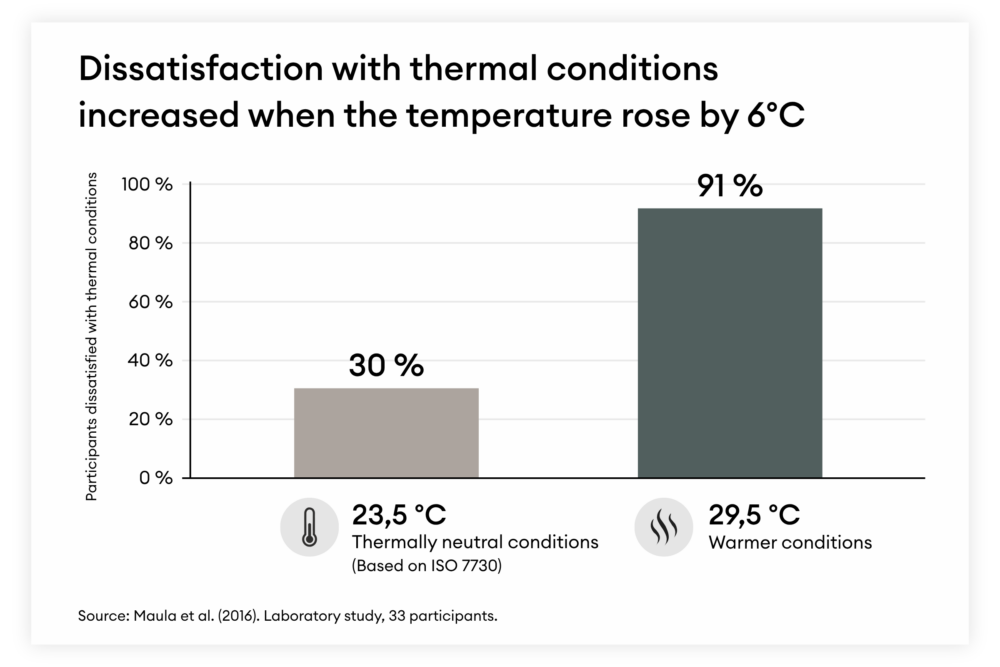
In a laboratory study by Maula and her colleagues, 33 participants worked under two temperature conditions: 23.5°C and 29.5°C. Ventilation remained at the same level in both conditions.
At 23.5°C, which falls within Finland's recommended range for light desk work, 30% of participants were dissatisfied with the thermal conditions. At 29.5°C, that figure rose to 91%. Participants also reported greater difficulty concentrating and considered the warmer environment less suitable for prolonged work.
The change also affected work performance, but not across all tasks. Performance declined in one working memory task under warmer conditions. No similar decline was observed in the other tasks studied.
The findings show that temperature can have a clear impact on how people experience their working environment. However, its effects on actual work performance also depend on the type of task.
What does CO₂ tell us about office ventilation?
Carbon dioxide (CO₂) levels are often used to assess office ventilation. CO₂ builds up indoors as people breathe, so elevated levels can indicate insufficient ventilation relative to the number of people using a space. However, CO₂ alone does not provide a complete picture of indoor air quality.
In another study by Maula and her colleagues, 36 participants worked under two different ventilation conditions. With higher ventilation, the CO₂ concentration was 540 ppm. With lower ventilation, it was 2,260 ppm (parts per million). The room temperature remained at 23.5°C in both conditions.
Under lower ventilation, participants performed slightly worse in information retrieval tasks and reported greater mental workload and a lack of energy.
One interesting finding was that participants noticed a difference in air freshness only at the beginning of the experiment. Air may not always feel noticeably worse when ventilation is reduced. This means that perceived freshness alone is not always a reliable indication of how well ventilation is working.
Why can the same temperature feel different?
Maula and her colleagues also observed an interesting connection between air quality and thermal conditions. Each can influence how the other is perceived.
In the temperature study, participants found stuffiness more distracting in the warmer environment, even though ventilation remained unchanged.
The ventilation study showed a connection in the other direction. With lower ventilation, participants found the temperature more distracting, even though the room temperature stayed the same.
The same temperature can therefore feel more uncomfortable when ventilation conditions change. Similarly, a warmer environment can make the air feel stuffier even without reducing ventilation.
If an office feels too warm or stuffy, adjusting the temperature alone may not solve the problem. It is also worth checking whether ventilation is sufficient for the number of occupants and how air moves around workstations.
How do poor air quality and thermal conditions affect the workday?
Problems with indoor conditions do not always have one obvious cause. They often become noticeable through recurring experiences: a room feels stuffy, drafts are uncomfortable, or employees begin avoiding certain workstations.
| Everyday observation | What could it indicate? | What should be checked? |
|---|---|---|
| A room feels stuffy toward the end of the day | Ventilation may not be sufficient for the occupancy level | Airflow rates, CO₂ levels, and number of occupants |
| Some employees feel cold while others feel too warm in the same space | People experience thermal conditions differently | Temperature, clothing, air movement, and workstation locations |
| Drafts make it difficult to concentrate | Air movement may cause localized discomfort | Air velocity, the source of airflow, and workstation placement |
| A workspace feels tiring to use | Indoor conditions may be one of several contributing factors | Ventilation, thermal conditions, and employee feedback |
Fatigue, headaches, and dry eyes can have many causes. These symptoms alone are not enough to conclude that indoor air quality is the problem.
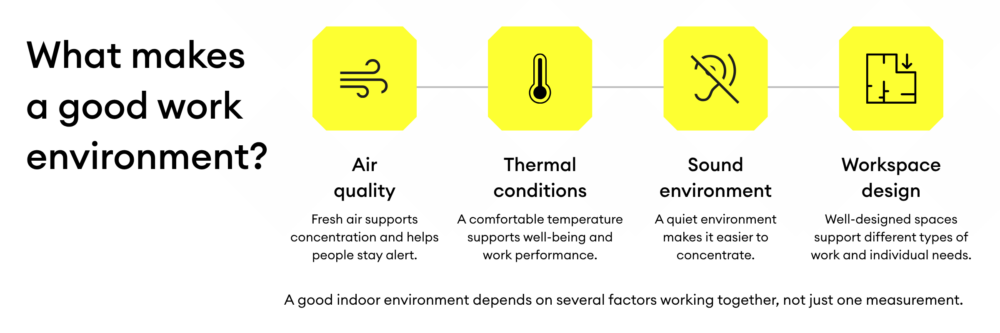
Measurements are important, but they cannot fully describe how different people experience the same space. Assessing indoor conditions therefore requires both measurement data and feedback from the people using the space.
The indoor environment also includes acoustics. In an earlier article, we explored how the office sound environment affects productivity and workplace well-being.
Who is responsible for the office indoor environment?
When problems with office air quality or thermal conditions arise, resolving them often requires cooperation between the property owner and the company using the space.
The building owner is generally responsible for technical building systems, depending on the agreed division of responsibilities. Tenants should also make sure that ventilation and thermal conditions are suitable for the intended use and number of occupants before choosing a space. If problems arise, checking the operation of the ventilation system and its airflow rates is a good starting point.
In Finland, employers are responsible for ensuring safe and healthy working conditions. The Occupational Safety and Health Administration provides guidance on investigating and addressing indoor air problems, including consulting occupational health professionals and indoor climate specialists. It also provides guidance on assessing thermal conditions at work.
Why is ventilation important in a soundproof workroom?
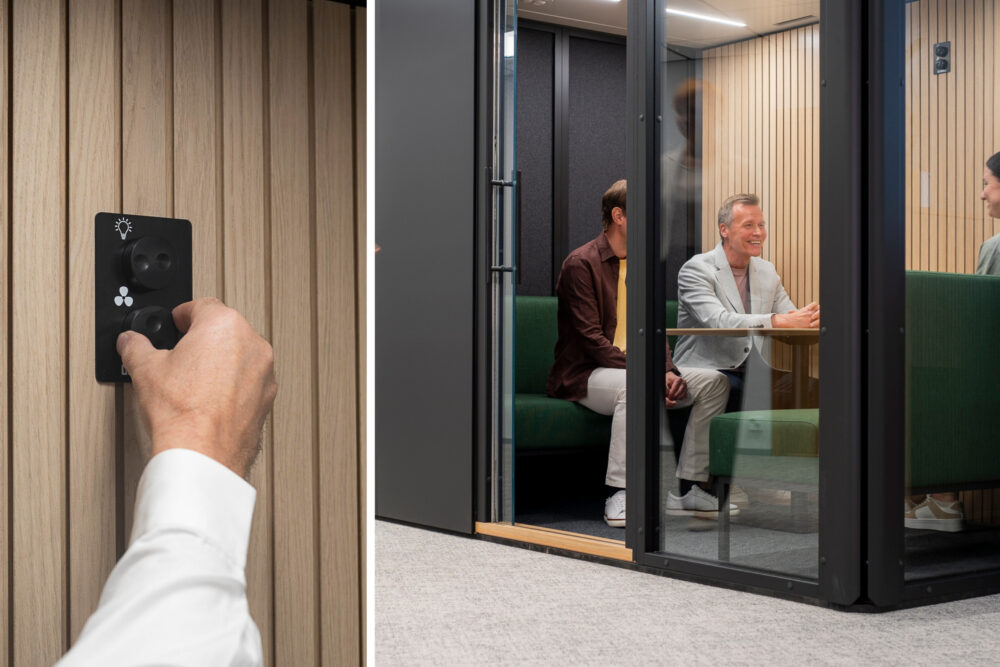
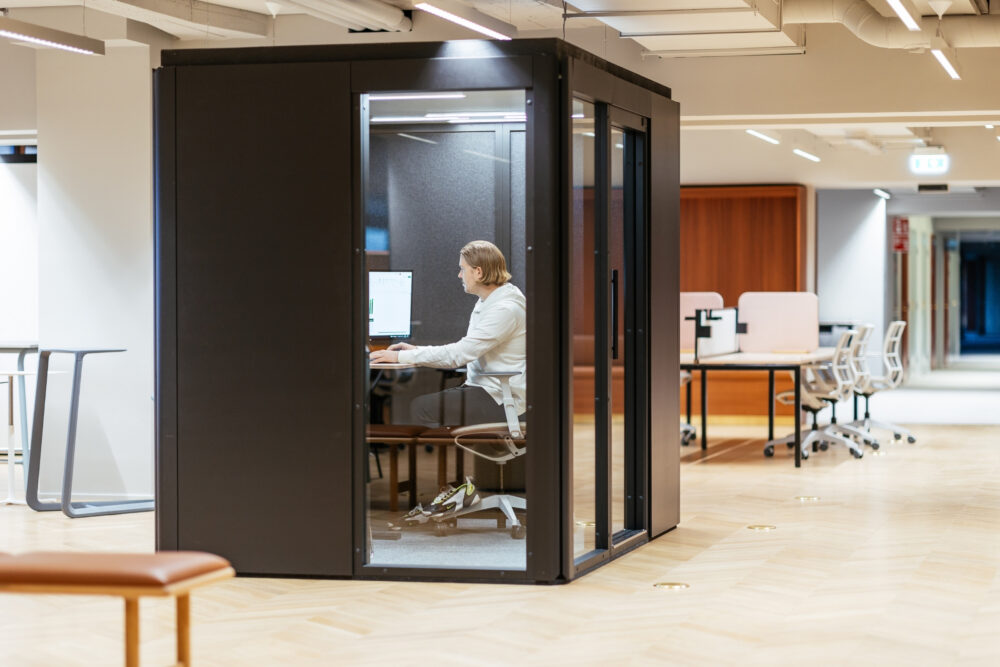
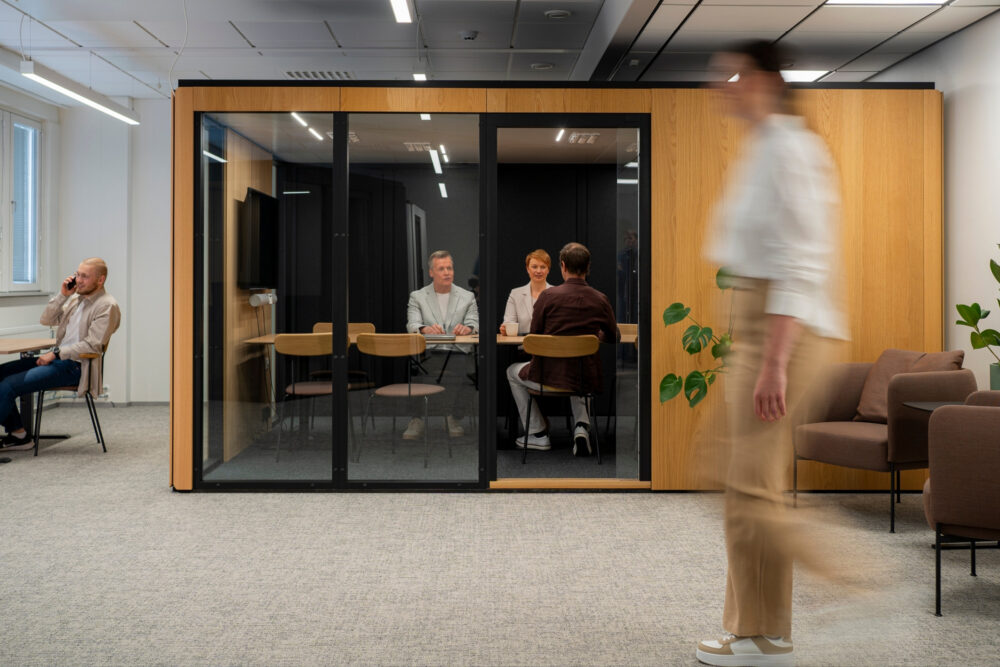
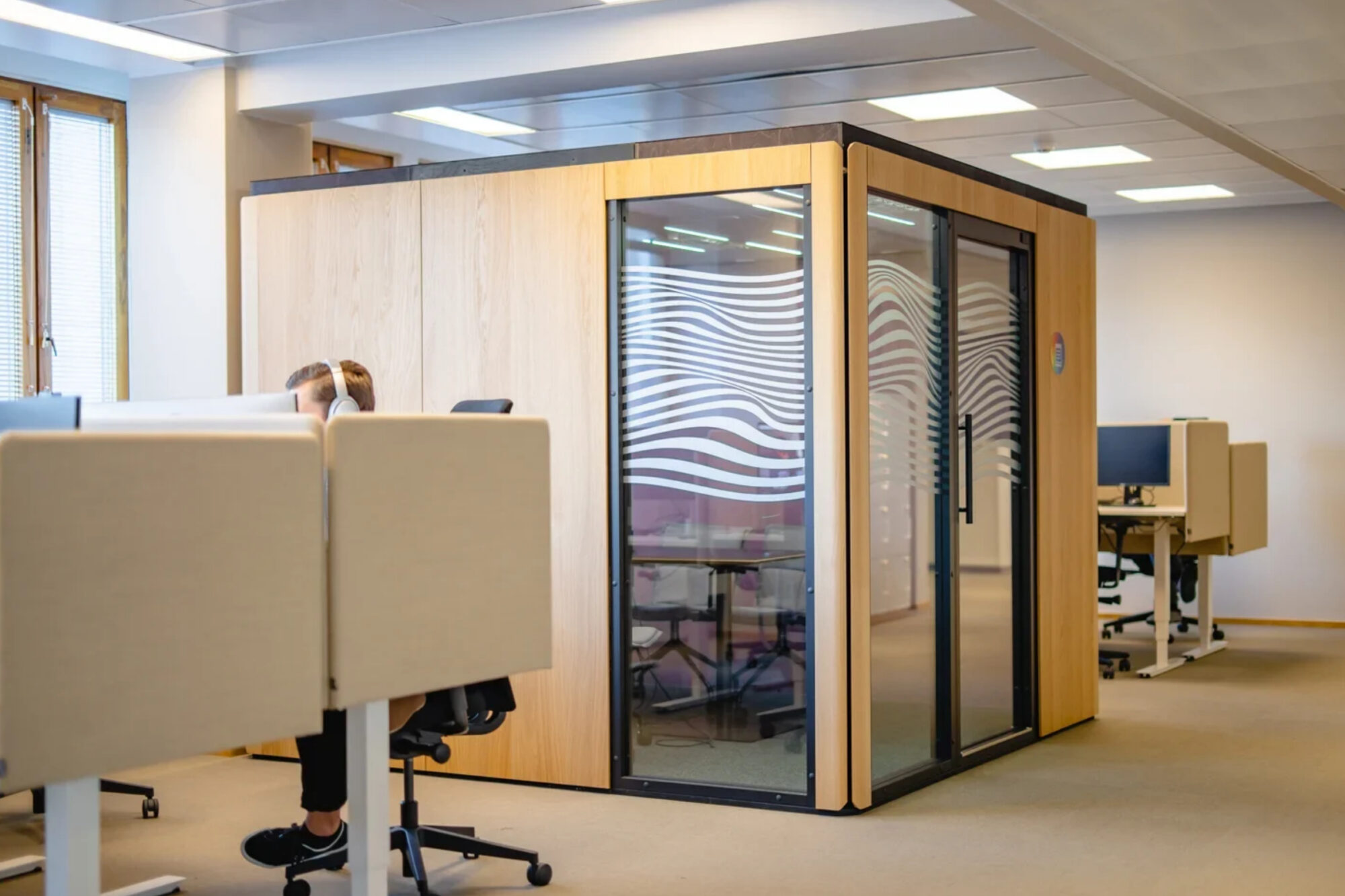
When you add soundproof phone booths, workrooms, or meeting rooms to an office, sound insulation is often the first consideration. Can employees speak without disturbing others? Will their conversations remain private?
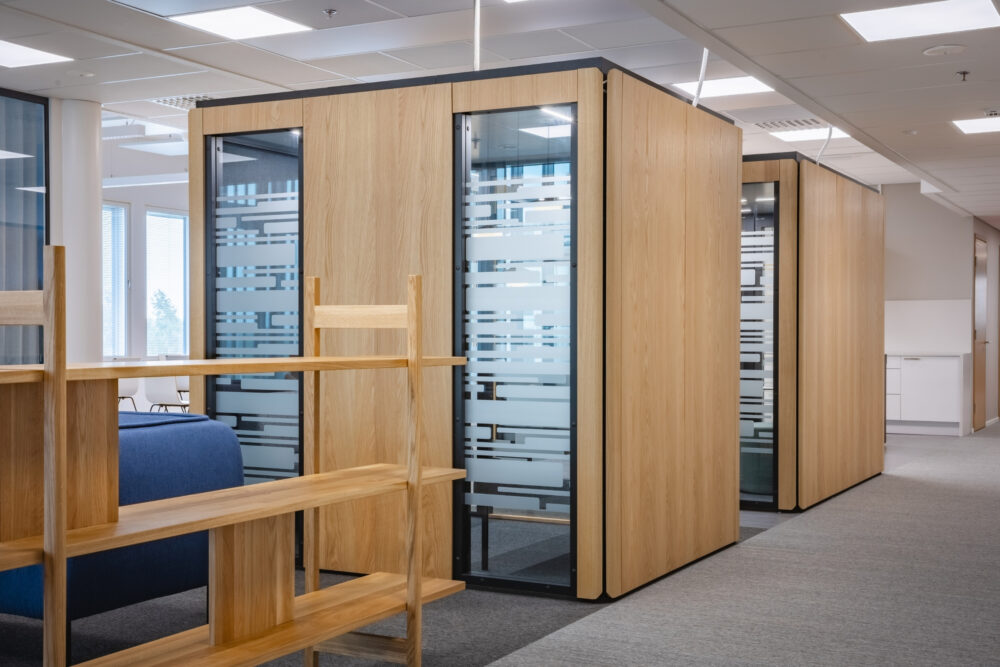
But sound insulation alone is not enough. In an enclosed workspace, ventilation needs to match the number of occupants and how the room is used, especially during longer video meetings and focused work. Air should be refreshed without creating distracting noise or uncomfortable drafts.
Octacell’s soundproof workrooms have quiet mechanical ventilation that users can adjust to their needs. Ventilation capacity varies depending on room size. Airflow is approximately 25 liters per second in the smallest single-person rooms and up to 125 liters per second in the largest rooms.
A good soundproof workspace is not just quiet. It also needs to be comfortable to use.
What are the key takeaways?
Office air quality and thermal conditions affect more than comfort. Research has also identified effects on concentration and performance in certain work tasks.
There is no single temperature or ventilation setting that works for everyone. That is why office conditions should be considered as a whole. Alongside measurements, it is important to listen to employees and address conditions that repeatedly interfere with their work.
Does your office have the right spaces for focused work and calls?
Our specialists can help you find soundproof workspaces that support phone calls, meetings, hybrid work, and focused work in your office.
Get in touch, and we will help you find the right solution for your space.