How the office sound environment affects productivity and workplace well-being
Blog
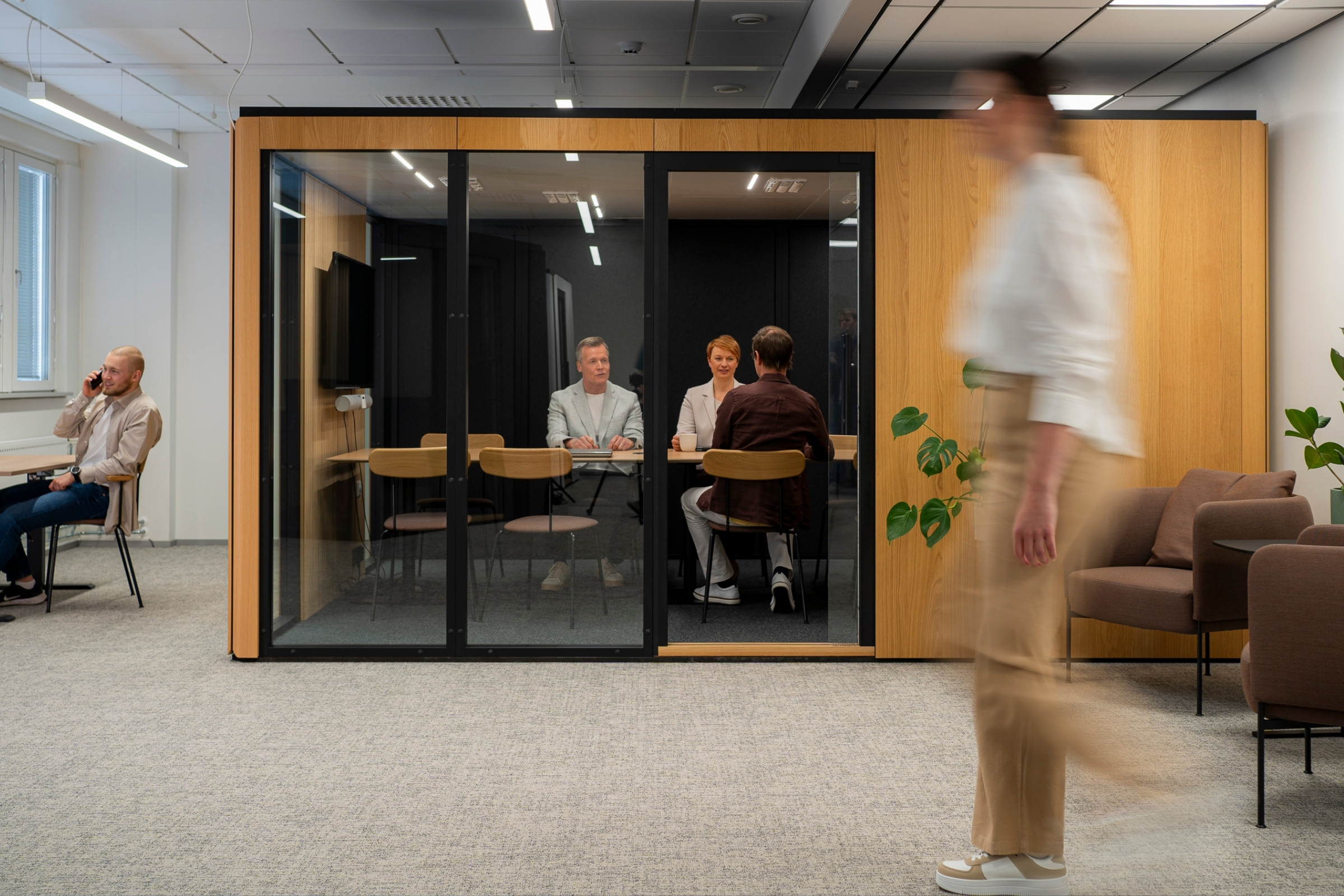
Office work has changed quickly. Hybrid models, remote meetings, and open work environments have made offices more versatile but also more demanding in terms of acoustics.
Noise is often seen as a comfort issue. In reality, it is also a question of productivity and cognitive load. A distracting sound environment can affect concentration, workflow, and the office's ability to support hybrid work. It also affects how well people can have confidential conversations and do their work without constant interruptions.
In knowledge work, the problem is usually not that sound is dangerously loud. The problem is that sound breaks concentration. When focus is interrupted even for a moment, the task has to be restarted mentally. During a workday, these micro-interruptions can happen dozens of times.
In this article, we look at the office sound environment as a whole: how to recognize common problems, how the building and workplace design both affect sound conditions, and how different acoustic challenges can be addressed.
The most distracting sound is not always the loudest
The office soundscape is made up of ordinary things: conversations, phone calls, remote meetings, footsteps, devices, building services, and sounds from shared spaces. But not all sound is equally distracting.
Clearly distinguishable speech is especially distracting. The reason is simple: the brain processes speech automatically, even when we are not trying to listen. If words and sentences can be understood from a nearby conversation, attention easily shifts away from the task at hand.
This is especially visible in work that requires:
- sustained concentration
- reading and writing
- analysis, planning, or decision-making
- confidential conversations
The situation is familiar in everyday office life. One employee is simply doing their normal work on a call or in a remote meeting, but the same sound interrupts another employee’s concentration.
In an earlier article, we looked more closely at why clearly distinguishable speech is one of the most distracting sounds in an office. Here, we take a broader look at how the overall office sound environment can be assessed and improved.
How can you tell when the office sound environment no longer supports work?
Few companies know exactly whether their office sound environment supports work or makes it more demanding. Sound conditions are not necessarily measured or assessed regularly, but the effects of a distracting sound environment are often visible in behavior: headphones are worn almost all day, calls are taken in corridors, and people are constantly looking for quiet places to work.
These are not just individual preferences. Often, they indicate that the space no longer matches the way work is actually done.
In the hybrid workplace, many things happen in the office at the same time: customer calls, video meetings, focused work and quick conversations with colleagues. If there are no suitable places for these activities, the sounds start to compete with each other. The office no longer supports the way people work. Instead, employees have to keep looking for a place where they can concentrate.
Research supports what people experience in everyday office life
Office sound environments have been studied widely both in Finland and internationally. In large international survey datasets, noise repeatedly appears as one of the most significant workplace environmental issues, alongside other indoor environment factors such as temperature, ventilation, and lighting.
In Finland, office sound environments have been studied, among others, by the Air, Sound and Perception research group at Turku University of Applied Sciences, led by Valtteri Hongisto. The group’s work has examined topics such as speech disturbance, speech privacy, office acoustics, and the effect of the sound environment on work performance.
One recurring finding in research is that intelligible speech is especially disruptive in tasks that require working memory and verbal processing. This is highly relevant in knowledge work, where much of the work involves reading, writing, thinking, and decision-making. When speech pulls attention away from the task, the effect is easily seen in both the flow of work and the perceived workload.
The effect of speech has also been studied through physiological stress responses. In a study by Radun, Maula, Rajala, Scheinin, and Hongisto, working during speech was experienced as more distracting and more demanding than working in silence or in steady noise. The study also found changes in factors such as cortisol levels and heart rate variability.
In practice, this means that a distracting sound environment does not just feel annoying. It can require extra effort from the employee even during an ordinary work task. If concentration has to be constantly protected from surrounding sounds, the load no longer comes only from the work itself, but also from the conditions in which the work is done. That is why the sound environment is also a workplace well-being issue, not just a detail of acoustics or comfort.
An open office is not automatically the problem
The problem is not the open office itself. The problem is a poorly managed sound environment.
In a well-designed office, speech does not carry unnecessarily far, focused work has a quiet place, and phone calls and remote meetings have dedicated spaces. In a poorly designed space, one call can disturb concentration across the entire open office.
In Finland, building sound conditions are also addressed in official regulation. The Decree of the Ministry of the Environment on the Acoustic Environment of Buildings states that the acoustic environment of a building must be designed and implemented according to the intended use of the space. In other words, the space should support the activities it is meant for.
Both the building owner and the tenant have an impact
The office sound environment cannot be solved with one product or one material choice. The basic acoustic level of a building is influenced by structures, sound insulation, sound-absorbing surfaces and the noise levels of building services.
In everyday work, however, acoustic comfort is also affected by the decisions made by the tenant and the user organization: workstation placement, quiet rooms, phone booths, furniture and the shared rules of the office.
Many organizations work in spaces that were not originally designed for the needs of today’s hybrid work. In those cases, the entire office does not necessarily need to be renovated. Often, it is enough to complement the space with solutions that create quiet, protected areas exactly where they are needed.
Common office acoustic challenges and practical solutions
| Workplace challenge | Solution |
|---|---|
| Remote meetings disturb the rest of the office | Soundproof phone booths or workrooms |
| Concentration is constantly interrupted | Quiet work areas and better space planning |
| Speech carries across the open office | Sound-absorbing surfaces, screens and layout changes |
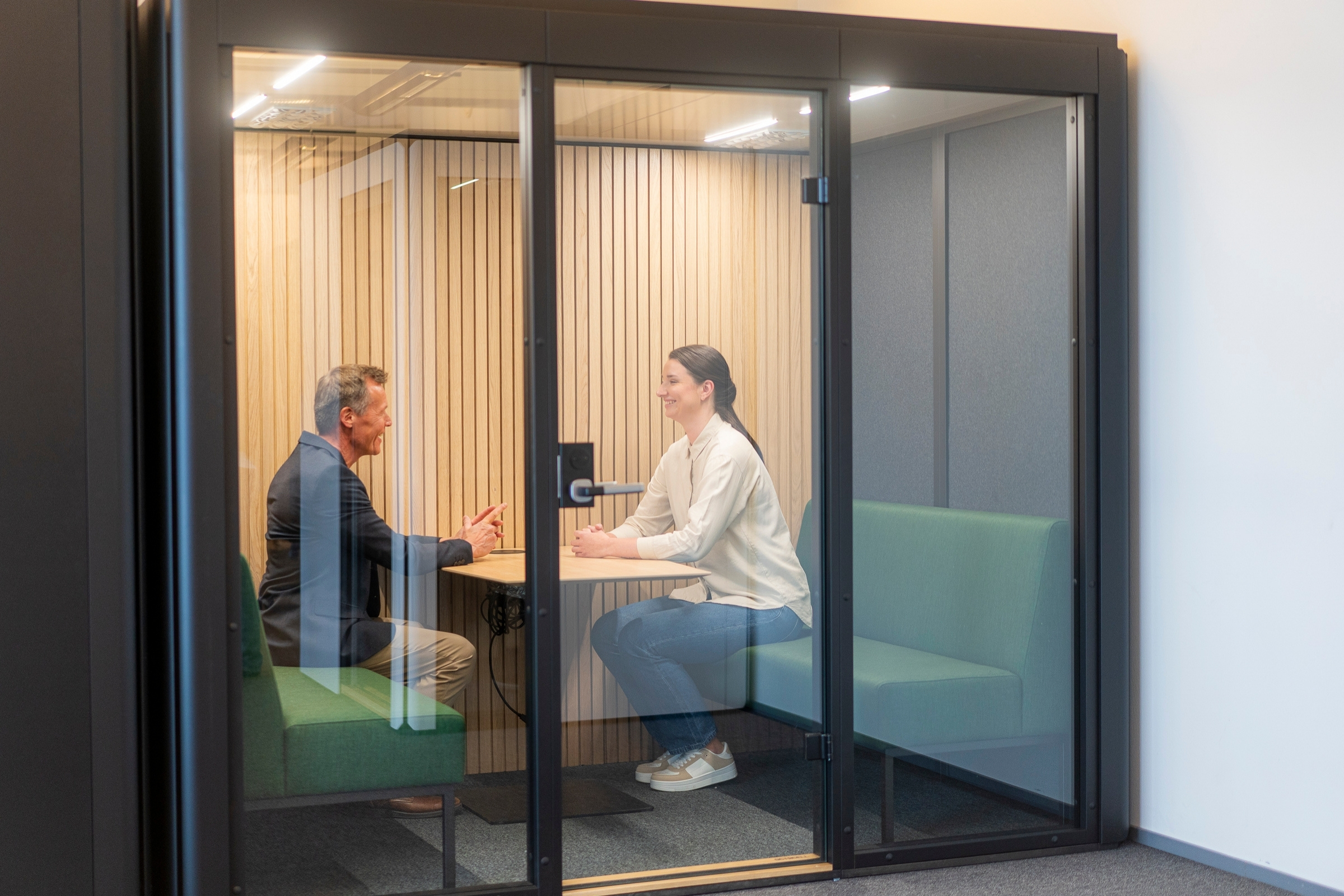
| Confidential conversations cannot be held | Enclosed workrooms and meeting rooms |
A good sound environment also improves space efficiency
The sound environment is also worth looking at from the perspective of space efficiency. If employees cannot find a suitable place for calls, meetings, or focused work, the space is not being used effectively, even if there is enough floor area on paper.
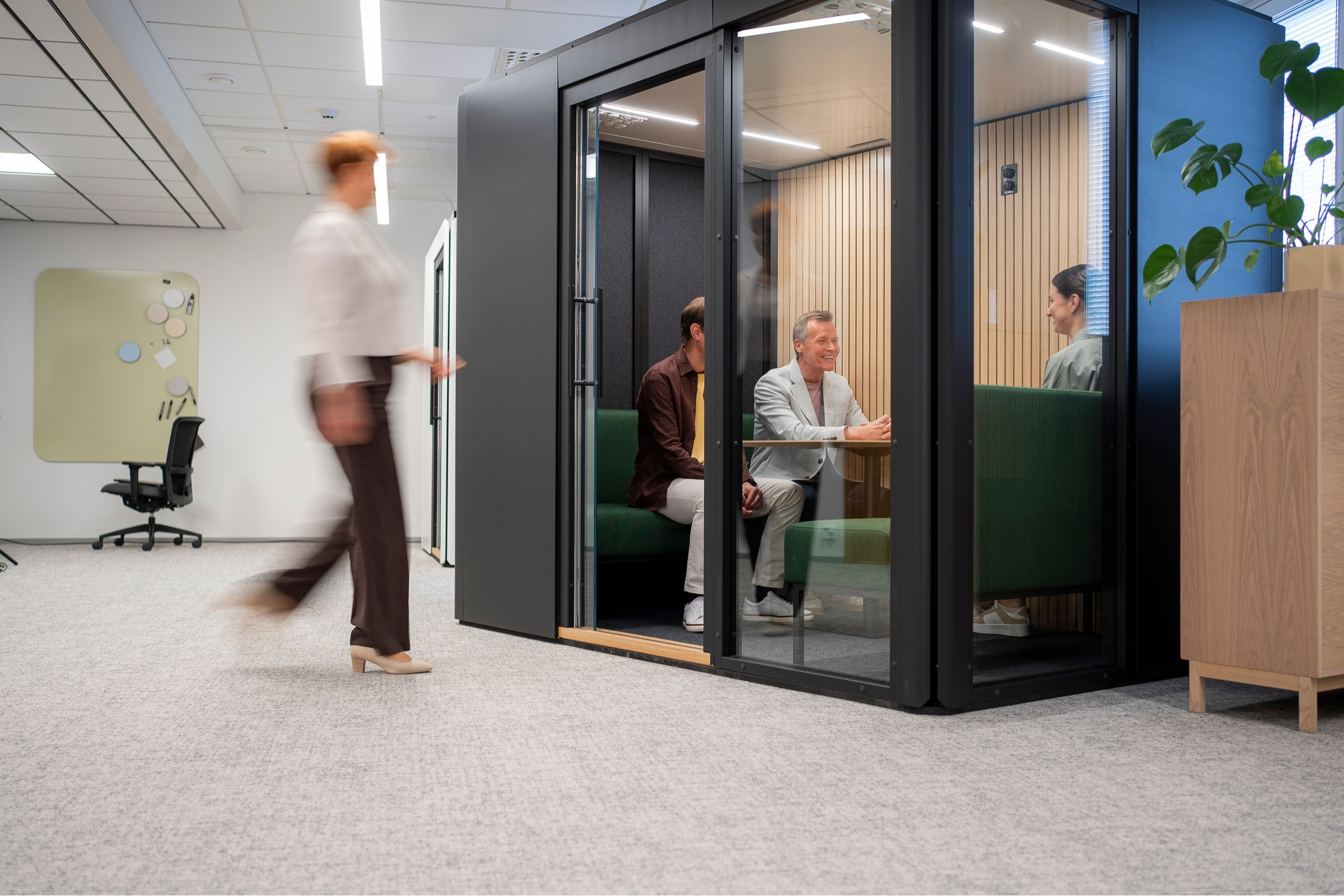
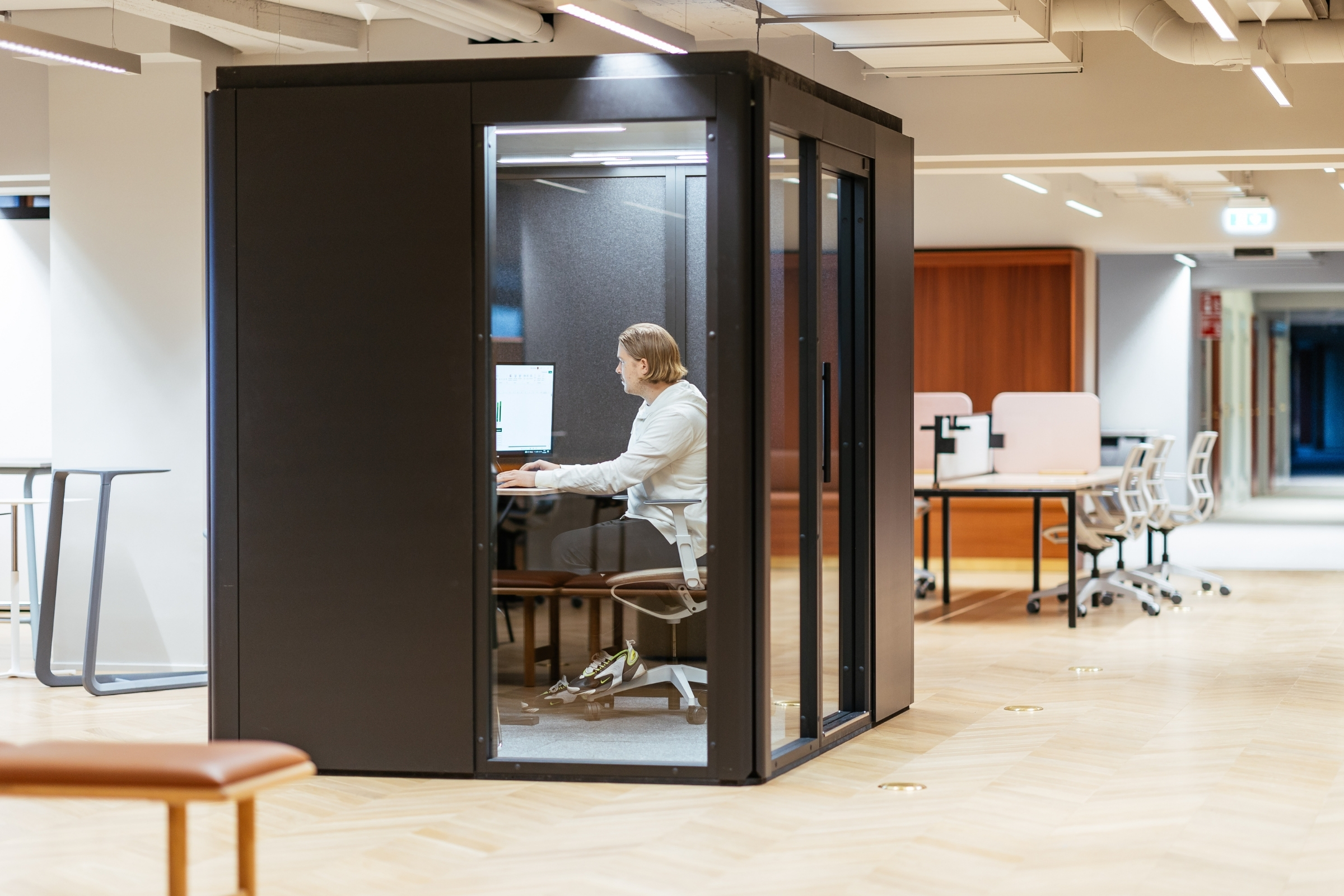
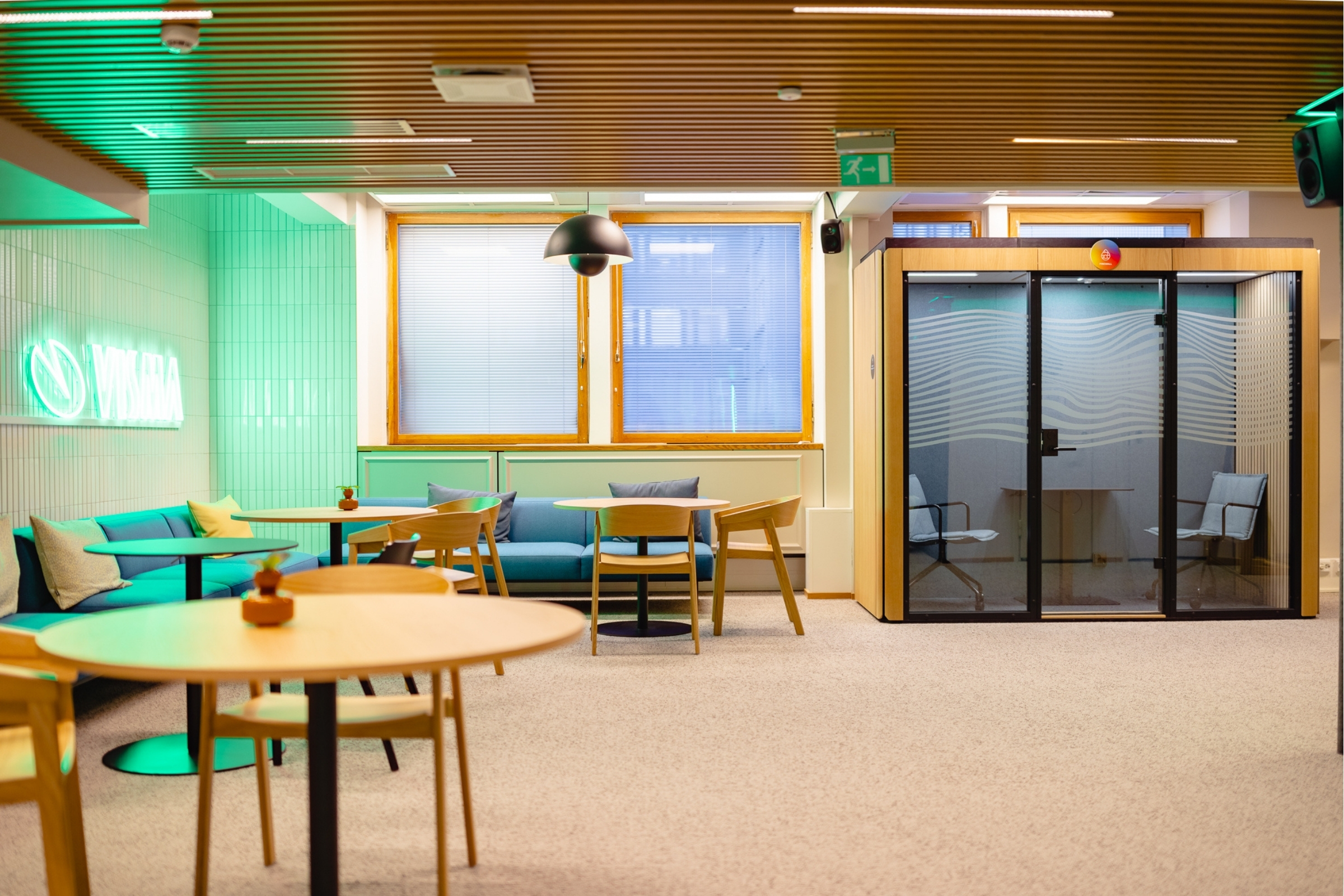
One way to improve the office sound environment is to add soundproof workrooms that can be moved or adapted as needs change. These spaces are not limited to short phone calls. They can also support video meetings, focused work and confidential conversations while making better use of the available floor area. When places for calls, hybrid meetings, and focused work can be added quickly, the office adapts better to the real needs of work.
From Octacell’s point of view, a good sound environment does not mean removing all sound. What matters more is that different situations have the right place. In practice, a functional solution takes into account:
- where sound is created
- where it travels
- where employees can do their work without disturbing others or being disturbed themselves
Octacell’s soundproof workspaces are designed for exactly this need: to add more controlled, adaptable and acoustically protected spaces to the office without heavy structural changes. When calls, meetings, and focused work each have the right place, the entire office sound environment works better.
A functional sound environment does not mean complete silence
A good office is not a place where nobody speaks. A functional sound environment means that sound is manageable. Employees know where they can focus, where they can speak, and where they can hold a meeting without disturbing others.
This is especially important in the hybrid workplace. The office needs to support both interaction and quiet work. In practice, a good sound environment is created through clear space division: places for calls, meetings, collaboration, and work that requires concentration.
When speech does not spread unnecessarily across the entire office, it becomes easier to concentrate and the space supports different ways of working more effectively.
Does your office have the right spaces for the way people work today?
Hybrid meetings, focused work, calls, and confidential discussions all have different acoustic requirements. When each activity has the right space, the office works better for everyone.
Our specialists can help assess your needs and identify which soundproof workspaces would best support your office now and as those needs change.
Get in touch and let’s find the right solution for your space.